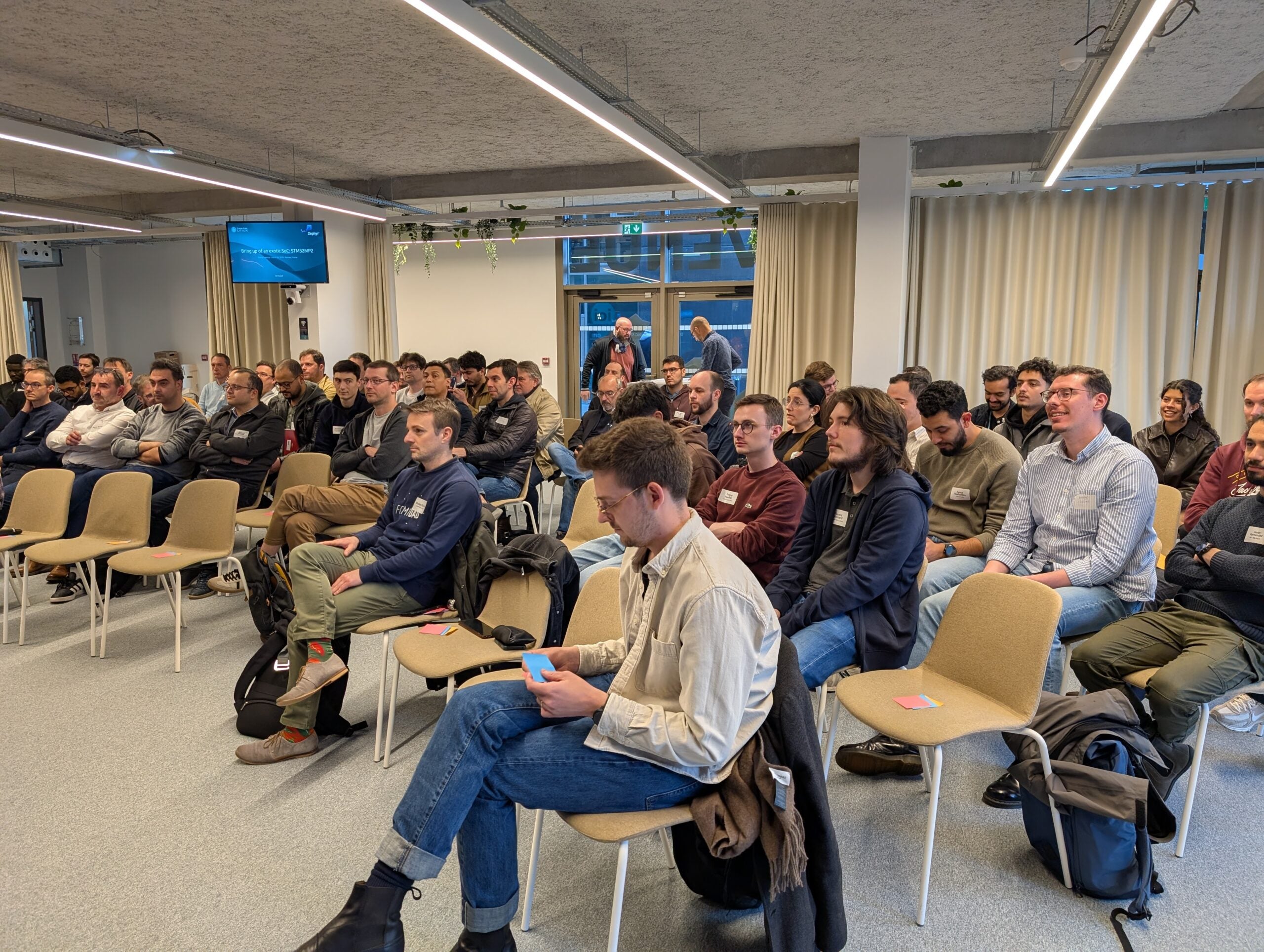
On March 26, 2026, the Zephyr community gathered in Rennes, France for an evening focused on open source collaboration, embedded systems innovation, and technical knowledge sharing. Organized by Savoir-faire Linux and Silicon Labs, the meetup took place at Le Poool in Cesson-Sévigné and welcomed developers and open source enthusiasts interested in Zephyr RTOS and embedded software development.
The event was part of the Zephyr Community Meetup Series, an initiative that supports local gatherings around the world to help grow and strengthen the Zephyr ecosystem. Throughout the evening, attendees explored topics ranging from Zephyr release engineering to heterogeneous SoC integration, AI-assisted development workflows, and real-world industrial applications powered by Zephyr.
Session Highlights:
The meetup opened with welcoming remarks from the Silicon Labs team before moving into a series of technical talks delivered by contributors and industry experts.
Zephyr Release Process – Johan Hedberg, Staff Software Engineer, Silicon Labs
One of the first presentations focused on the evolution of the Zephyr release process. Johan Hedberg from Silicon Labs shared insights into how the project has scaled its release management practices over the years while maintaining an efficient contribution workflow for developers and maintainers.
As Zephyr marks its 10-year anniversary, Johan reflected on the project’s evolution from a small initiative with only a few participating companies into one of the leading open source RTOS platforms for embedded systems. He shared how increasing contributor activity and project complexity led to the development of stronger automation, distributed maintainership, and robust CI workflows.
The session also highlighted the role of the Zephyr Release Engineering Team, which oversees bug triage, merge processes, release coordination, and project stability. Today, the project regularly handles dozens of pull requests daily while maintaining strict review and testing requirements before code is merged.
Bring up of an exotic SoC: the STM32MP2, Zini Youssef, Embedded Systems Engineer, Savoir-faire Linux
In this session, Zini Youssef, Embedded Systems Engineer at Savoir-faire Linux, presented the journey of porting Zephyr RTOS to the STM32MP2 heterogeneous SoC platform. The talk explored how running Zephyr on the Cortex-M33 as a co-processor alongside Linux on the Cortex-A35 introduces new architectural and integration challenges compared to traditional microcontroller bring-up workflows.
The presentation covered key technical hurdles including secure peripheral access, clock management controlled by the Cortex-A35, adapting drivers and device tree bindings, interrupt handling, linker customization, and integration with the Remote Processor framework. Zini also shared insights into the debugging process, collaboration with STMicroelectronics, and the experience of upstreaming support to the Zephyr community.
The session concluded with a demonstration showcasing Zephyr running on the STM32MP2 in a low-power industrial use case using OpenAMP communication between Linux and Zephyr.
The case of memory chip shortage: replacing Linux with Zephyr, the long and short journey – Josuah Demangeon, Firmware, Panoramix Labs
In this session, Josuah Demangeon from Panoramix Labs explored how memory chip shortages can influence embedded system design decisions and motivate a transition from Linux-based systems to Zephyr RTOS. The talk focused on video and camera applications, where Linux systems often depend on external DDR memory, creating additional supply chain and hardware constraints.
Josuah discussed how Zephyr’s significantly lower memory requirements can make it possible to run applications without external RAM in certain scenarios, potentially allowing existing hardware platforms to continue operating even when memory components become difficult to source.
The presentation also examined the trade-offs between Linux and Zephyr ecosystems, particularly in multimedia and video processing. While Linux currently provides a much more mature software stack for camera pipelines, streaming, and image processing, the talk highlighted ongoing efforts within the Zephyr ecosystem to develop similar capabilities, including media APIs, video frameworks, and streaming infrastructure.
Another engaging session examined the growing role of Large Language Models in embedded systems development. Benjamin Cabé from the Zephyr Project discussed practical use cases for AI-assisted workflows, including documentation improvements, driver development, and code review support, while also addressing the limitations and risks developers should keep in mind when using these tools.
Live Demos:
Following the presentations, attendees gathered in the demo and networking area where several live demonstrations showcased Zephyr running on modern embedded platforms and industrial use cases.
Demo Highlights:
- A showcase of Zephyr portability across Silicon Labs platforms using a common application framework supporting Bluetooth, Matter, and Wi-Fi solutions.
- A hybrid STM32MP2 architecture combining Zephyr and Linux through OpenAMP for industrial data processing applications
- A real-time people detection pipeline on STM32N6 using embedded AI acceleration, video processing, and USB streaming
These demos provided participants with hands-on exposure to how Zephyr is enabling scalable, low-power, and high-performance embedded solutions across different hardware ecosystems.
Community:
Beyond the technical content, the meetup created valuable opportunities for community interaction. Developers, maintainers, students, and first-time attendees exchanged ideas, discussed ongoing projects, and connected with others working in embedded systems. The Rennes meetup demonstrated the continued growth of the Zephyr community in France.
Thanks to:
A sincere thank you to all speakers, attendees, organizers, and community members who helped make the event a success. To view the photos from the meetup, check out the Flickr gallery here.
We look forward to future Zephyr community meetups and continued collaboration across the embedded and open source ecosystem.
About the Community Meetups:
This meetup is part of the Zephyr Community Meetup Series, gatherings hosted by community members, with support from the Zephyr Project.
If you are excited about the Zephyr Project and want to share it with your local community, consider hosting an event in your city. Whether you are in Rennes or halfway across the globe, we encourage passionate individuals to get involved. Reach out to us and explore how you can bring Zephyr to your community and make a difference in the world of IoT development.
To keep up to date about the project, subscribe to the Zephyr quarterly newsletter or connect with us on @ZephyrIoT, Zephyr Project LinkedIn or the Zephyr Discord Channel to talk with community and TSC members.