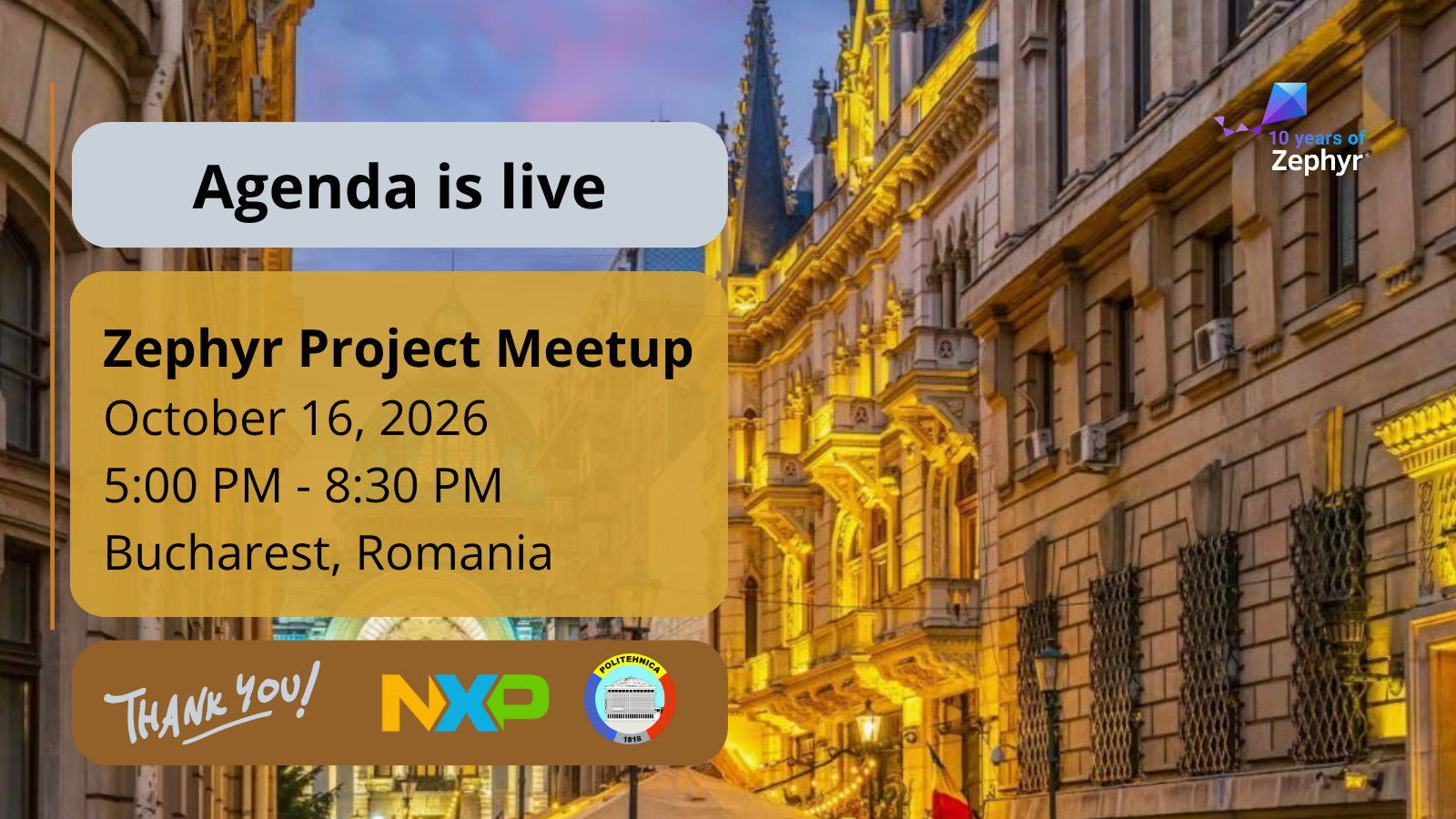
The Zephyr Project community is heading to Bucharest, Romania!
Join us on Friday, October 16, 2026, for an in-person Zephyr Project Meetup organized by NXP Semiconductors and hosted by Politehnica University of Bucharest at the UNSTPB Central Library. NXP is also sponsoring food, beverages, and development board giveaways.
The event is open to developers, engineers, contributors, students, technology professionals, and anyone interested in open source, embedded systems programming, and software development. Whether you are an experienced Zephyr developer or are just beginning to explore embedded technologies, you are welcome to join.
About the Organizer and Host:
NXP Semiconductors is organizing this meetup to bring the Zephyr community together in Bucharest, with additional support through food, beverages, and development board giveaways.
Politehnica University of Bucharest is hosting the meetup at its UNSTPB Central Library, providing a space for the local embedded systems and open source community to meet, learn, and exchange ideas.
What to Expect:
The meetup will feature technical presentations about products running Zephyr, subsystems, practical development experiences, and features you may not have explored yet. Attendees will also have opportunities to ask questions, exchange ideas, and connect with members of the local open source and embedded systems community.
Event Details:
- Date: October 16, 2026
- Time: 5:00 pm – 8:30 pm
- Location: UNSTPB Central Library, Politehnica University of Bucharest
- Address: Splaiul Independenței 313, 060042 Bucharest, Romania
- Meetup Organizer: NXP Semiconductors
- Host: Politehnica University of Bucharest
- Food, Beverages, and Development Board Sponsor: NXP Semiconductors
Agenda
5:00 – 5:30 pm – Welcome drinks and snacks
5:30 – 5:40 pm – Welcome note from host team – NXP and Politehnica University of Bucharest
5:40 – 5:55 pm – Getting Started with Zephyr: What Still Breaks and Why- Alexandra Maracine, NXP Semiconductors
Getting started with Zephyr has become much easier in recent years thanks to improvements in upstream tooling and the availability of vendor-provided installers. Despite this progress, environment setup is still one of the most common challenges developers face when starting a new project.
Through our work on integrating Zephyr support, we have seen a wide range of setup issues across different operating systems and development environments. In this talk, we will share some of the most common problems encountered by developers, including Python environment conflicts, SDK version mismatches, corporate proxy restrictions, operating system specific limitations, and tooling compatibility issues.
Based on real support cases and integration experience, we will discuss recurring failure patterns, the root causes behind them, and practical lessons learned while helping developers get started with Zephyr. We will also look at how recent additions such as west sdk install and west packages pip –install have improved the onboarding experience, along with areas where setup can still be challenging.
Attendees will leave with a better understanding of common Zephyr setup pitfalls, practical recommendations for avoiding them, and insights into how the developer onboarding experience can continue to improve across the Zephyr ecosystem.
6:00 – 6:15 pm – SenseRing – building an open source smart ring – Dan Tudose, Politehnica University Bucharest
This presentation will follow the complete journey of SenseRing, from the initial idea for a smart ring and the definition of its core features to the creation of fully functional prototypes.
I will cover the main stages of development, including sensor and component selection, hardware and PCB design, miniaturization, firmware development, mechanical integration, and power management.
I will also discuss the engineering trade-offs, the problems encountered, the iterations that failed, and the lessons learned along the way.
By the end, participants will see how an idea can be transformed into a real wearable product and experience the working SenseRing prototypes firsthand.
6:20 – 6:35 pm – Developing Tools for Zephyr: Lessons and Challenges – Georgiana Boglis, Software Engineer,NXP Semiconductors
Integrating Zephyr RTOS into a general-purpose embedded IDE exposes challenges in build orchestration, environment management, and different developer expectations. Zephyr is not one tool but a stack — CMake, west, Devicetree, Kconfig, sysbuild, Twister — designed primarily for command-line use, not for integration into an IDE.
This talk shares lessons learned from developing Zephyr support in a Visual Studio Code extension, including the decisions made when implementing a DeviceTree viewer and how the workflow evolved to a CMake/west approach, with sysbuild and MCUboot multi-image builds, per-domain runners and RTOS-aware debug views.
I will present practical issues encountered in setting up Zephyr environments — particularly around toolchain, Python and version compatibility and how these were addressed through a version-aware installer that encapsulates dependencies per Zephyr release and isolates Python in dedicated virtual environments.
Attendees will gain actionable insights into tooling trade-offs, common integration challenges, and concrete opportunities to improve the Zephyr development experience.
6:40 – 7:05 pm – Break time
7:05 – 7:35 pm – Chasing the Sample Rate: FPGA-Driven Acquisition on Zephyr – Raluca Bozdog, Engineer, Embedded Software, Analog Devices Romania
Sustained high-rate acquisition – streaming a precision ADC through FPGA fabric into the CPU – forces you through Zephyr’s cache, MMU, DMA, and interrupt subsystems all at once, creating pitfalls that each team currently rediscovers independently.
Getting there meant bringing a family of FPGA IP-core drivers to Zephyr – SPI Engine, DMA controller, clock and PWM generators – and making them work together at speed on a Zynq-7000 with an AD4630 precision ADC. This talk shares the patterns behind it: zero-copy buffering, coherent DMA, interrupt-driven and multi-block transfers, all while keeping the drivers portable. Each pattern is grounded in real problems and measured results, so that our incremental, lessons-learned development serves as a backbone for future Zephyr projects chasing million-samples-per-second streaming.
7:40 – 8:10 pm – Bridging Cores with Zephyr IPC – Iuliana Prodan, Software Engineer, NXP Semiconductors
Multicore MCUs need their cores to talk. Zephyr’s IPC service provides one backend-agnostic API for it. This talk covers the endpoint model, the devicetree setup and the main backends (RPMsg, RPMsg-Lite, ICMsg, ICBMsg), with a two-core example and a look at zero-copy. Gain an understanding of backend selection criteria and the fundamentals of sending a first cross-core message.
8:10 – 8:30 pm – Networking
Registration
Registration is required to help the hosts plan the space and event logistics. Seats are limited, so register soon to secure your place. Register for the meetup here.
Thank You to Our Supporters
Thank you to NXP Semiconductors for organizing the meetup and sponsoring food, beverages, and development board giveaways, and to Politehnica University of Bucharest for hosting the event at the UNSTPB Central Library.
We also appreciate the speakers, volunteers, and attendees whose participation makes this event possible.
Support an Upcoming Zephyr Meetup
Interested in sponsoring development board giveaways or food and beverages for an upcoming Zephyr meetup? Complete the sponsorship interest form, and our organizers will contact you with event details and coordination information.
About the Zephyr Community Meetups
This meetup is part of the Zephyr Community Meetup Series, a collection of local gatherings hosted by community members with support from the Zephyr Project.
These events provide a welcoming space for developers, students, researchers, and embedded systems enthusiasts to exchange technical knowledge, present real-world projects, discuss challenges, and build stronger local open source communities.
Whether you are based in Bucharest, Romania, or another part of the world, we encourage community members, companies, universities, and developer groups to get involved.
Reach out to us and explore how you can bring Zephyr to your community and make a difference in the world of IoT development.
To keep up to date about the project, subscribe to the Zephyr quarterly newsletter or connect with us on @ZephyrIoT, Zephyr Project LinkedIn or the Zephyr Discord Channel to talk with community and TSC members.
We look forward to seeing everyone in Bucharest, Romania!