
Written by Abitzen Xavier – Silicon Labs, 2026 Chairman of the Governing Board Zephyr Project
Happy New Year. As we approach the 10-year anniversary of the Zephyr Project, I am honored and humbled to step into the role of Chair of the Zephyr Board of Directors for 2026. Before we set our sights on the future, let’s take a moment to appreciate how far we’ve come.
 Ten years ago, a small group of visionaries from Intel/Windriver, NXP, Synopsys believed the world was going to need a different kind of RTOS – something tiny, secure, portable, and built in the open from day one for the coming wave of connected devices. When Zephyr was introduced at Embedded World 2016, it was just that: a compact RTOS with an 8 KB–512 KB footprint, a portable architecture, and an early promise of open governance and strong security practices. At the time, it was ambitious. Today, it’s hard to imagine the embedded landscape without it.
A Look Back: Ten Years of Key Achievements
Over the last decade, Zephyr has evolved from a small RTOS initiative into one of the most trusted, scalable, and forward-looking open-source platforms for embedded and connected devices. The collective contributions of our maintainers, companies, developers, and community members have made Zephyr a foundational technology across consumer, industrial, medical, and numerous other markets.
From a Small RTOS to a Complete Embedded Platform
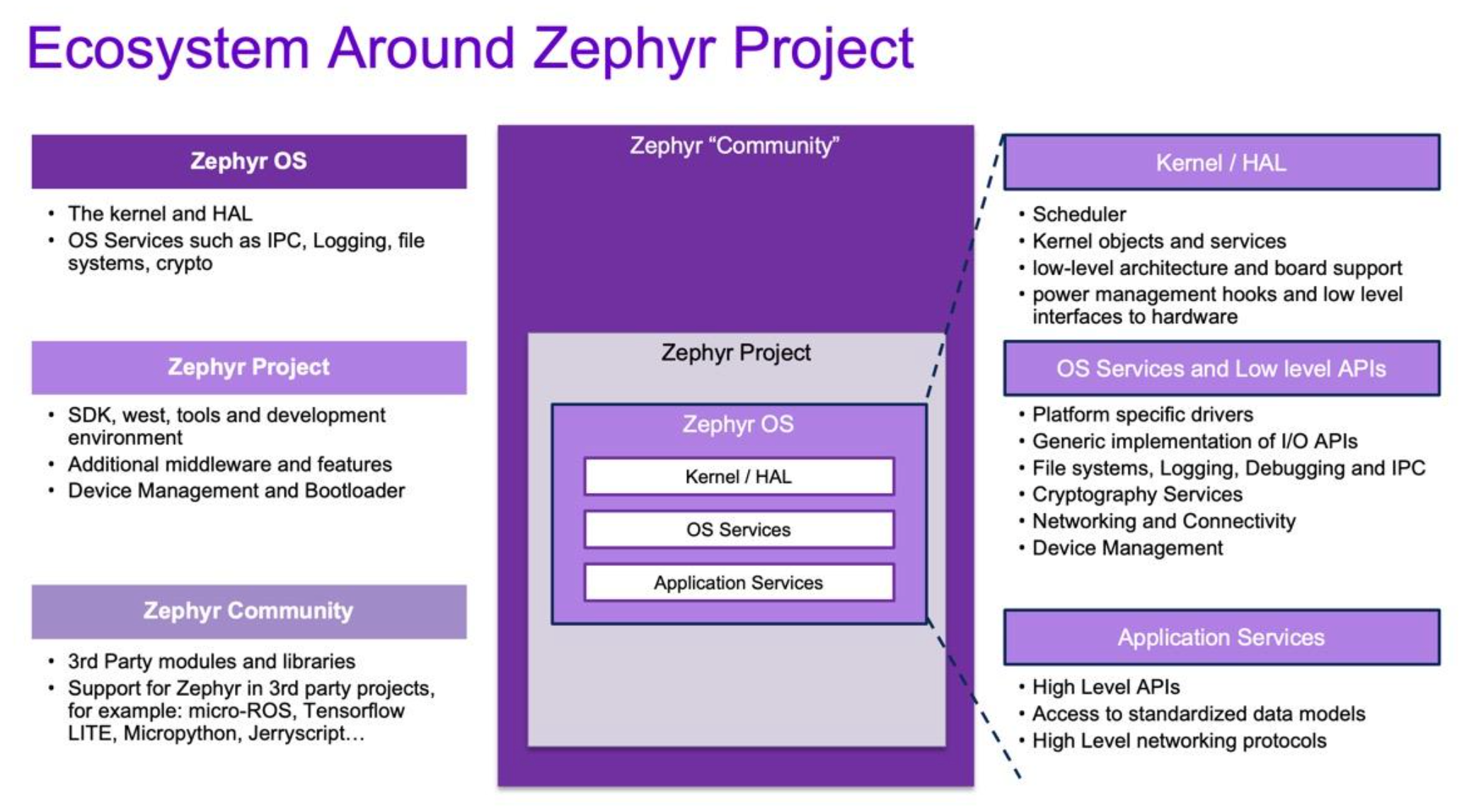
When Zephyr launched, we supported only a handful of boards. Fast forward to today: that list has grown to 900+ boards across 8+ different architectures, dozens of vendors and 275+ sensors. That’s not just a statistic—it represents thousands of hours of engineering effort contributed by companies, maintainers, and individual developers who believe in a shared platform for embedded innovation. Along the way, Zephyr has evolved from “just an RTOS” into a complete embedded platform.
What began as a minimal kernel and a small set of device drivers has expanded into:
- A modern scheduler and rich kernel services
- Filesystems, logging, debugging, cryptography, and power management
- Networking and connectivity stacks
- High-level APIs and standardized data models
- Device management capabilities and emerging application frameworks
Security: Built In, Not Bolted On
One of the things I’m proudest of in this community is that security has never been an afterthought. From the very beginning, Zephyr put a formal Security Committee in place, along with secure coding practices and a clear process for handling vulnerabilities. Over the years, that early focus has matured into a strong, transparent security posture, including:
- Establish a formal vulnerability response and disclosure program
- Becoming a CVE Numbering Authority (CNA) in 2017
- Earning the Core Infrastructure Initiative Gold Badge in 2018
- Adding automated SBOM generation starting in 2021
- Improving CVE automation with our migration to GitHub infrastructure in 2021
- Forming a dedicated Security Working Group in 2022
- Completing a third-party NCC Group security audit in 2024
None of this is glamorous work. It’s policy, process, automation, and lots of iteration. But it’s exactly what’s required if you want an open-source platform to be trusted in critical environments. Our commitment is simple: Zephyr must be one of the most secure open embedded platforms available—and we intend to keep raising that bar.
Raising the Bar on Safety
As embedded systems show up in more mission-critical applications—industrial automation, mobility, healthcare—the expectations around safety grow with them. We’ve heard that clearly from our members and users. In response, Zephyr is on a multi-phase path toward IEC 61508 SIL 3 / SC 3 functional safety certification. This isn’t just a checkbox; it’s a deep investment in how we design, build, and verify the software at the core of Zephyr.
So far, we’ve:
- Implemented MISRA-based coding guidelines
- Integrated static analysis tools into our workflows
- Added requirements and traceability into the codebase
- Automated documentation through StrictDoc
We’re also exploring how this work can extend to domains like automotive through standards such as ISO 26262, depending on member interest and demand. Safety is a journey, and we’re still on it—but the direction is clear, and the progress is real.
A Thriving, Diverse Ecosystem
Zephyr’s story is, at its core, a community story. What began with a small set of founding members in 2016 has grown into a large and diverse ecosystem of semiconductor leaders, automotive innovators, consumer technology companies, training and consulting partners, wireless connectivity leaders and tooling partners.
This diversity is one of our greatest strengths. It means Zephyr reflects real-world needs across industries and geographies. It also means no single company is dictating the roadmap—the platform is shaped by shared priorities and real deployment experience. Our Technical Steering Committee (TSC) has matured alongside this growth, with balanced representation and scalable governance to ensure decisions are transparent, inclusive, and sustainable as the contributor base expands.
Making Developers’ Lives Easier
You can’t have a healthy project without happy developers. Over the last decade, we’ve invested heavily in developer experience and tooling. Zephyr today is much more approachable than it was in its early days, thanks to:
- Emulation and simulation environments that let you get started without hardware
- Cross-platform toolchains and debuggers
- IDE integrations and graphical tooling
- Support for TinyML, robotics, remote management frameworks
- Security and compliance libraries
All of this is aimed at a simple goal: whether you’re bringing up your first board or deploying thousands of devices, Zephyr should help you move faster, not slow you down.
Zephyr in the Real World
One of the most rewarding parts of this journey is seeing Zephyr quietly running inside real products: sensors in the field, consumer devices in homes, industrial equipment on factory floors, medical and smart energy solutions, wireless modules, and beyond. We don’t always get to talk publicly about every deployment, but we see the momentum in other ways: growing community calls, more conference talks and workshops, more questions and answers online, and more companies standardizing on Zephyr for their embedded strategy. What started as a bet has become a foundation.
The Road Ahead: Building the Next 10 Years Together
The next decade is a huge opportunity for Zephyr and for everyone building on it. We’re moving from “just enabling IoT” on a device to becoming an intelligent connected ecosystem: AI at the edge, quantum-resilient security, and deeply connected systems that span everything from homes and factories to entire cities.
Expanding Connectivity
Zephyr already supports one of the broadest connectivity portfolios in the embedded world—BLE, Wi-Fi, Thread, Ethernet, CAN, and many others. But the story doesn’t end there. New radios, new protocols, and new use cases are arriving fast. Over the coming years, I expect the community to continue adding and hardening connectivity options so developers can reach for Zephyr whenever they need a device to talk securely and reliably to… well, anything.
Intelligence at the Edge
We’re entering a world where tiny devices will do far more than sense and report. Microcontrollers will run AI inference, detect anomalies locally, adapt to their environment, and cooperate with other nodes at the edge. Zephyr’s determinism, modular design, and cross-architecture support make it an ideal foundation for this shift. Our challenge—and our opportunity—is to make Zephyr the place where AI on microcontrollers feels natural, not experimental.
Preparing for the Quantum Era
Quantum computing isn’t mainstream yet, but its impact on security is already clear. Devices being deployed today may still be in the field when quantum attacks become practical. That’s why Zephyr needs to evolve toward post-quantum cryptography (PQC): integrating quantum-resistant primitives, updating protocols, and giving product teams a clear path to keep long-lived devices secure. It’s forward-looking work, but it’s work we can’t afford to ignore.
Ecosystem Growth: Strength Through Community
Zephyr’s biggest strength has always been its community. Interoperability and standardization will matter more as devices need to work together across vendors, ecosystems, and clouds. Over the next decade, we want to welcome even more voices:
- Silicon vendors pushing the limits of low-power, high-performance hardware
- Device makers building new user experiences on top of Zephyr
- Standards bodies and industry alliances aligning on interoperable, open solutions
- Educators helping the next generation of embedded developers learn Zephyr first
We’ll keep investing in tools, documentation, and education so that getting started with Zephyr is as easy as staying with Zephyr for the long haul. As the project expands into areas like smart cities, robotics, industrial automation, and beyond, the impact of this community will only grow.
Join Us in Shaping the Future of Intelligent, Connected Devices
Let’s shape the next decade of embedded innovation together. Zephyr’s real strength isn’t just the code—it’s the people who build, ship, and teach with it. I’m genuinely excited to see what we’ll create as a community in the years ahead. Whether you’re a developer, engineer, architect, educator, or company leader, 2026 is a great time to get involved. Our shared goal is simple: a future where embedded devices are intelligent, secure, connected, maintainable, and open.
We’ll be kicking off a year-long celebration of Zephyr’s 10th anniversary at embedded world 2026. If you’re there, come visit us at the Zephyr booth, say hello, and join the celebration.