The Zephyr Project community is heading to London, UK!
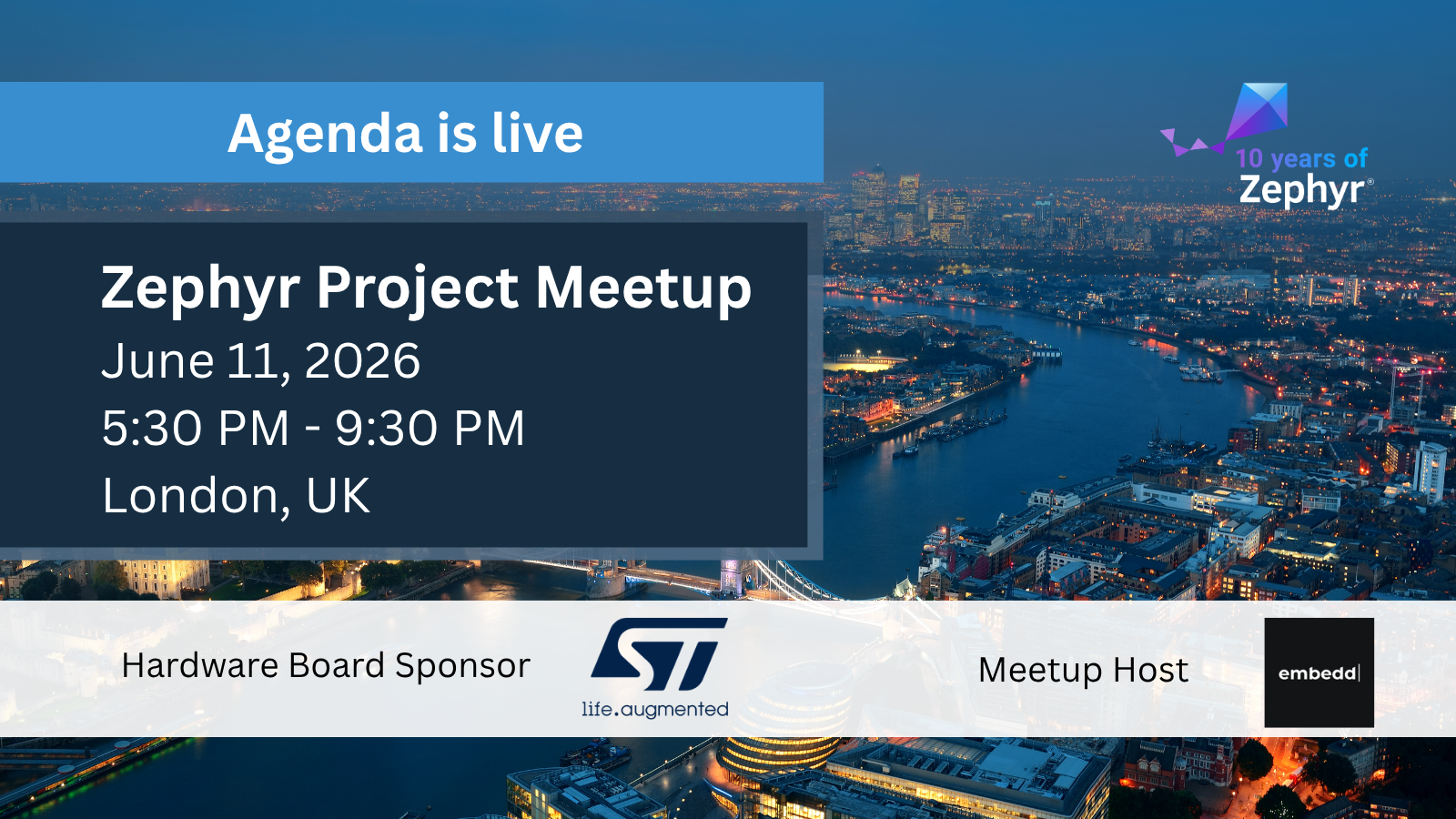
Join us on Thursday, June 11, 2026, for an in-person Zephyr Project Meetup hosted by embedd.it at The Chapel at Elmtree, 32 Welbeck St, London W1G 8EU.
This meetup is open to anyone interested in open source, embedded systems programming, software development, dependable systems, and low-power connected devices. Whether you are an experienced Zephyr contributor, an embedded systems professional, or just beginning to explore real-time operating systems, this gathering is a great opportunity to learn, connect, and exchange ideas with the community.
What to Expect
The meetup will feature presentations and discussions focused on products running Zephyr, project subsystems, and features that attendees may not have explored yet. It is designed to bring together developers, users, contributors, and organizations working with or interested in the Zephyr RTOS.
Attendees will have the chance to:
- Learn from technical talks and real-world Zephyr use cases
- Connect with embedded systems developers and open source contributors
- Explore dependable, low-power embedded systems
- Meet community members from across the Zephyr ecosystem
- Discover new ways to get involved in the project
Agenda:
5:30 pm – 6:00 pm – Welcome snacks and drinks
6:00 pm – 6:05 pm – Welcome Note – Embedd.it team
6:05 pm – 6:20 pm – No Board, No Problem: Hardware-Free UART Driver Development in Zephyr – Bayrem Gharsellaoui, R&D Firmware Engineer, Machnet Medical Robotics (15 mins)
In this talk, Bayrem will present a practical workflow for developing a UART protocol driver in Zephyr without relying on a target MCU during the early stages.
Using a simple setup based on a Linux PC running Zephyr’s native_sim target and a USB-to-UART (FTDI) cable, he will show how you can interact directly with real hardware from your development machine. This makes it easier to iterate quickly, debug communication, and validate driver logic before moving to an embedded board.
This approach can be applied to many UART-based devices, including cellular modems, GPS receivers, Bluetooth modules, LoRa radios, barcode scanners, and industrial sensors, enabling faster prototyping, easier debugging, and better separation between driver logic and hardware.
6:30 pm – 7:00 pm – Zephyr RTOS: 10 Years, 1000 Boards, so What’s Next? – Kate Stewart, VP, Dependable Embedded Systems, Linux Foundation (30 mins)
Ten years ago, Zephyr set out to solve a problem that many embedded teams quietly struggled with: how to build dependable real-time systems without being locked into a single vendor, toolchain, or proprietary stack. What followed was more than steady adoption. Zephyr introduced a new model built around portability, adoption of security best practices, modern tooling, and a shared ecosystem of drivers and middleware.
The combination of applying open source and security best practices and aiming to fill the gaps that embedded developers flagged in our initial research has helped steer Zephyr’s development. Following these practices has steadily resulted in more developers adopting it as an efficient and effective way to create products, which has led to over 1000 boards being upstreamed in the project.
As we look forward to the next 10 years, we again reached out to survey organizations that are using Zephyr, as well as those that are not, to identify what are the gaps, and what areas are important to developers. This talk will go through some of the insights we’ve gained from that survey and provide a peek at the topics that the community will be addressing in the upcoming years.
7:10 pm – 7:25 pm – Inside the Bite: How Zephyr Powers Our Smart Mouthguard – Nicholas Savva, Firmware Engineer, & Christopher Kwan, Firmware Engineer, ORB Innovations (15 minutes)
What does it take to put a real-time operating system inside a mouthguard? At ORB Innovations, we specialise in smart oral wearables. In 2024, we launched ORB Sport, the world’s first heart-rate tracking smart mouthguard for sports and wellness, tracking everything from heart rate to head impacts.
In this talk, ORB’s firmware team will share how the Zephyr Project and nRF Connect SDK helped us bring ORB Sport to life, why Zephyr became central to our firmware stack, and what we’ve learned building reliable embedded software for one of the most space-constrained wearables in sport.
7:30 pm – 7:45 pm – Break Time
7:45 pm – 8:00 pm – 10 Tips for Learning Zephyr RTOS – Roy Jamil, Ac6
Zephyr is powerful, but its learning curve is famously steep, not because the concepts are hard, but because newcomers fight the framework instead of working with it. Most early frustration comes from a handful of recurring misunderstandings: treating Zephyr like bare-metal C or a FreeRTOS-style environment, misreading the build system, or pasting in AI-hallucinated Kconfig and devicetree options.In this talk, the speaker will distill lessons from teaching Zephyr RTOS into ten practical tips that flatten the curve. Along the way you’ll pick up the habits that separate smooth projects from painful ones, and leave with a clearer mental model and far fewer dead ends.
8:10 pm – 8:25 pm – Cross platform Bluetooth development for Zephyr – Donatien Garnier, Co-founder, Blecon – 15 minutes
We will share how we’ve been developing and testing Bluetooth devices in Zephyr: how we’re leveraging devcontainers and simulation toolkits to develop faster and more reliably, and how we’re now supercharging our process using AI tools. The audience will learn how they can leverage a similar approach to develop their own Bluetooth products with Zephyr.
8:35 pm – 8:55 pm – Digital Twins: A Hardware Context Layer for Faster Zephyr Enablement – Michael Lazarenko, Co-founder, Embedd (15 minutes)
Chip knowledge is still scattered across datasheets, SVD files, SDKs, example code, and vendor-specific tools. That makes Zephyr enablement slower than it should be, especially when building drivers, BSPs, bindings, and devicetree configurations.
This talk introduces the idea of a digital twin for silicon: a structured, machine-readable model of how a chip behaves. Instead of treating datasheets and SDKs as disconnected inputs, the digital twin becomes a reusable hardware context layer that can accelerate Zephyr driver development, generate devicetree output, support BSP creation, ground AI tools, and eventually power emulation and testing.
9:00 pm onwards – Closing game and thank you note – Michael Lazarenko, Co-founder, Embedd and team
Plan Your Week in London
The Zephyr Project Meetup takes place during the same week as the ELISA Project Workshop, happening June 9–11, 2026, also in London.
The ELISA Project Workshop brings together contributors, members, and partners to collaborate, accelerate progress, and plan future goals for Linux in safety-critical systems. For those interested in embedded, open source, and safety-critical software, this is a great opportunity to attend both events in the same week. Learn more about the ELISA workshop.
Registration Is Required
Seats are limited, and registration is required so the hosts can plan the space and logistics accordingly. Register now to secure your spot.
Message from the host team
Embedd is proud to support this Zephyr Meetup and to give back to a community we hold in high regard. Zephyr has done something rare: it has shown that embedded developers do not have to trade away portability, security, or openness to ship dependable products. That mission, lowering the barriers that slow embedded teams down, is one we care deeply about and want to help carry forward.
In that spirit, we have released a free, public devicetree configurator, a small contribution toward removing one of Zephyr’s better-known adoption hurdles and simplifying the path from hardware to a working configuration. As a young company we have already learned a great deal here, so we come first to listen, to share what we are building, and to support the developers who make Zephyr what it is. We look forward to meeting fellow enthusiasts, exchanging ideas, and helping shape the project’s next chapter.
Thanks to Our Supporters
Thanks to embedd.it for hosting the meetup and providing the space, food, and beverages. We also appreciate STMicroelectronics for sponsoring hardware board giveaways for attendees.
About the Community Meetups:
This meetup is part of the Zephyr Community Meetup Series, gatherings hosted by community members, with support from the Zephyr Project.
If you are excited about the Zephyr Project and want to share it with your local community, consider hosting an event in your city. Whether you are in London or halfway across the globe, we encourage passionate individuals to get involved.
Reach out to us and explore how you can bring Zephyr to your community and make a difference in the world of IoT development.
To keep up to date about the project, subscribe to the Zephyr quarterly newsletter or connect with us on @ZephyrIoT, Zephyr Project LinkedIn or the Zephyr Discord Channel to talk with community and TSC members.
We look forward to seeing you in London!